Post-Thrombotic Syndrome and Endovascular Treatment
A safe and effective minimally invasive technique to treat post-thrombotic syndrome by venous recanalisation. Performed under precise radiological guidance by an expert team.
What Is Post-Thrombotic Syndrome?
Post-thrombotic syndrome is defined as a chronic complication of deep vein thrombosis of the lower limbs (phlebitis), combining oedema of one or both lower limbs, pain particularly when standing or during exertion, trophic disorders or venous ulcers.
Post-thrombotic syndrome complicates 20 to 50% of symptomatic acute deep vein thromboses within two years despite effective anticoagulant treatment. This condition causes a major reduction in patients' quality of life, with an estimated annual cost per patient of €400 for moderate post-thrombotic syndrome and €1,000 for severe post-thrombotic syndrome.
Until recently, treatment of this condition was based on medical management combining preventive measures, compression stockings, and if necessary long-term anticoagulant therapy. Surgical treatment involving valvular repair and bypass was offered only exceptionally.
For the past 10 years, interventional radiologists have been performing mechanical recanalisation with dilation of stenosed veins and, most often, placement of self-expanding stents to relieve haemodynamically significant obstructions, whether occlusions or stenoses. Medium-term results are very encouraging, as all studies show a technical success rate > 90%, clinical improvement of approximately 99%, with more than 70% of patients completely asymptomatic after recanalisation.
Who Is Venous Recanalisation For?
Clinical conditions:
For patients whose clinical score for post-thrombotic syndrome is > C3 (C3: Oedema, C4: Venous trophic disorder (pigmentation, venous eczema, hypodermitis), C5: C4 and healed ulcer, C6: C4 and active ulcer).
Or post-phlebitic venous symptoms (pain, heavy legs, pruritus).
Anatomical conditions:
The location of obstructions must be at the femoral, iliac or inferior vena cava level.
Preliminary Additional Examinations
Doppler Ultrasound:
This allows assessment of the entire venous network, particularly upstream of the obstruction.
Phlebography CT scan or Phlebography:
These two examinations allow precise mapping of the venous network before the procedure. Ideally, a vein on the dorsum of the foot is punctured and iodinated contrast agent is injected from the foot to the inferior vena cava.
A quality-of-life questionnaire and clinical examination
Procedure
Depending on the case and with your consent, the procedure will be performed under sedation or general anaesthesia, as it is a lengthy intervention of more than 2 hours.
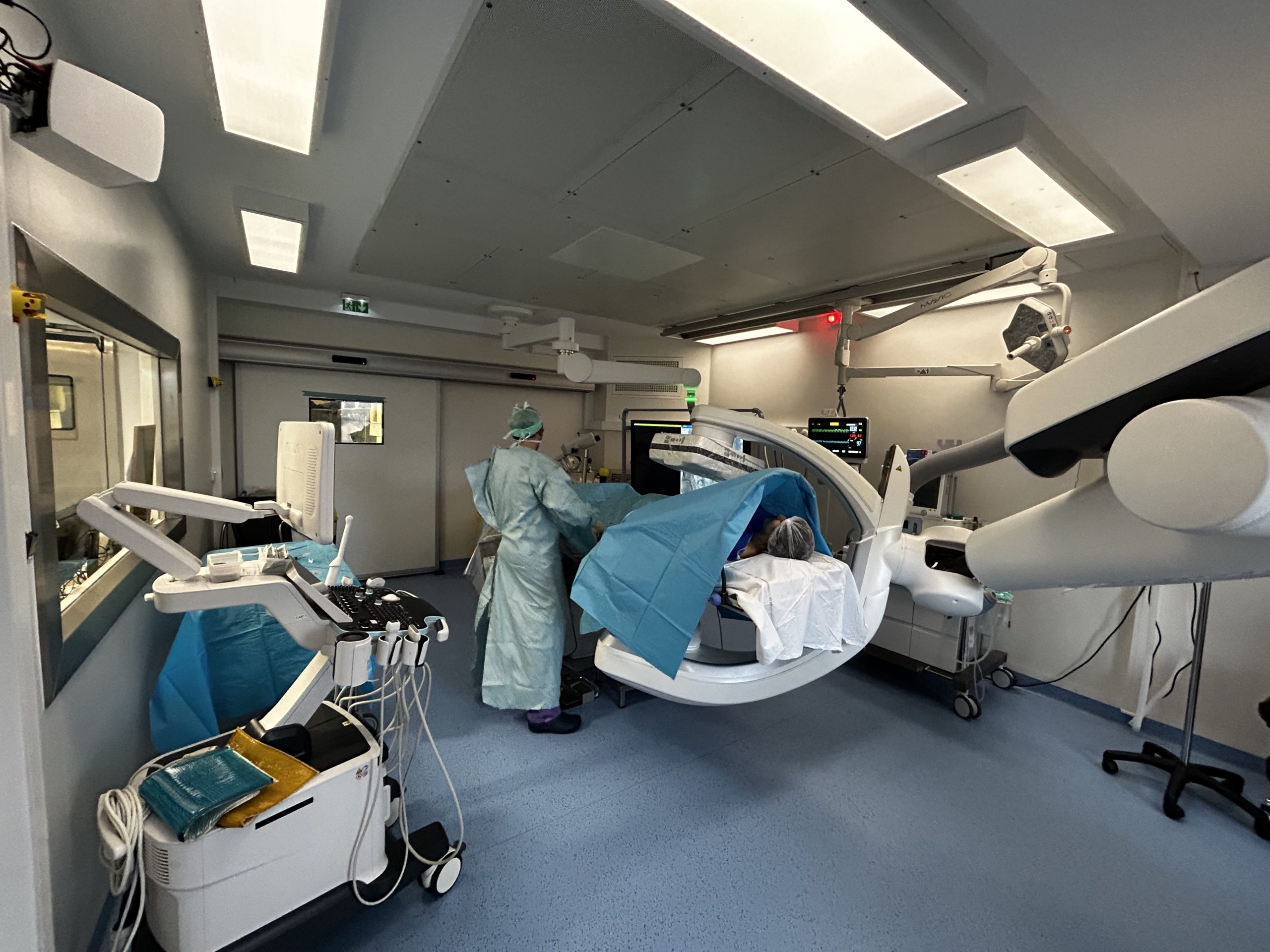
The procedure begins with a puncture of one or two veins chosen by the operator (groin fold, cervical region) to introduce a small plastic tube called an introducer, into which a catheter and guidewire are placed, then directed by the radiologist. The guidewire allows progression through the narrowing or occlusion to cross it completely. Once the occlusion is crossed by the guidewire, dilation through the guidewire is performed along the entire obstructed vein. Depending on the results of dilation, self-expanding endoprostheses (stents) are placed from the proximal to the healthy distal portion.
What Are the Risks of Venous Recanalisation?
Any intervention on the human body, even performed under competent and safe conditions, carries a risk of complication.
- Venous perforation by misdirection with haematoma
- Haematoma at the puncture site(s)
- New thrombosis of the treated segment
- Lumbar or groin pain at the stent site
- Intolerance reaction (mainly in patients with allergic background) related to iodinated contrast injection. Generally transient and not serious; severe complications are very rare (urticaria, Quincke oedema, anaphylactic shock…). The risk of death is exceptional (less than one case per 100,000).
- Renal adverse events, also related to iodinated contrast, are possible in patients with conditions affecting kidney function.
- Infection is exceptional following recanalisation.
- Embolic risks with pulmonary embolism.
- Radiation risks: If in the weeks following the procedure you notice redness or hair loss on your skin, localised to the explored region, do not hesitate to contact the medical team who treated you so they can ensure your follow-up.
After the Procedure
The patient is discharged 24 hours after the procedure or the same evening (day-case hospitalisation).
- Aspirin for 1 month and oral anticoagulant for at least 3 months is required.
- Compression stockings or varicose vein stockings must be worn for at least 3 months.
- Doppler ultrasound follow-up is required at 1 month, 3 months, 6 months and 1 year.
Ready to book an appointment?
Contact us to discuss your situation and schedule your consultation
Book an appointment